
WHY WE BUILT THIS
The story behind The Landscaper's Edge – and the proof for every claim we make.
It always started the same way. I'd install a new edging product, and for a few months it held. Then it would start to go — warping, heaving, cracking, creeping up out of the ground and by the following spring it was a mess. In a year or so it looked worse than the bare dirt I'd started with. So I'd tear it out and try something else.
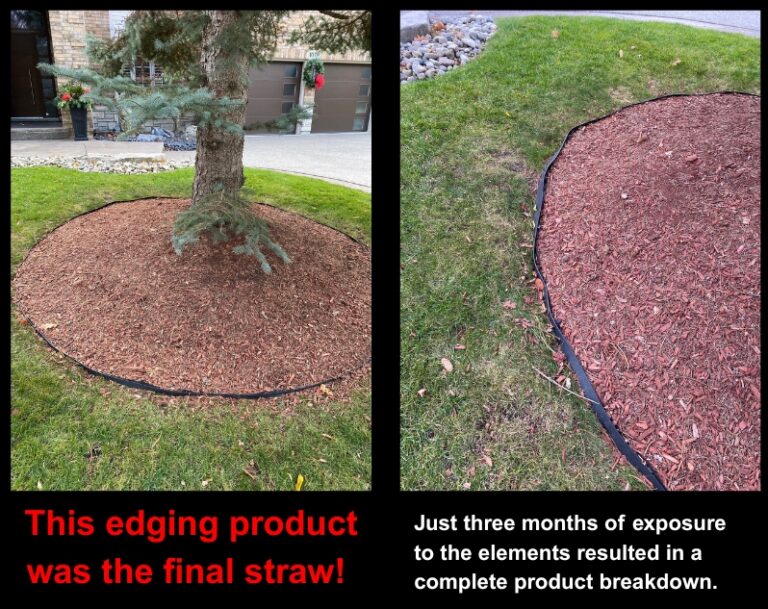
The promises of – "No-dig." "Heavy-duty." "Commercial-grade." "UV-stable." – were empty. Every label assured me that this edging was different. Every one failed the same way. And each time, I'd stand in the yard and think: why doesn't someone just make edging that actually works?
I knew this was a solvable problem. I have experience in inventing products, so I got a select group of knowledgeable people and together we developed and tested until we came up with the landscapers edge.
Below, you can watch it do every single thing we say it does.
EVERY CLAIM, PROVEN
We're not going to tell you it works. We're going to show you.
Every claim on the home page links straight to the spot below where you can watch it happen or see it for yourself.
It bends into a tight tree ring — no kink, no spread.
WHAT YOU'RE USED TO
Aluminum won't take the curve. Plastic buckles, and the ring's joiners spread apart by mid-summer.
Tree ring — ~90 seconds, one continuous take
Forming the tight circle, hitting a real root and shifting the anchor an inch to reseat, then topped with fresh mulch. No cuts.
WHY IT HOLDS
The Edge strip forms a tight radius cleanly, and because the anchors sit on top of the grade, a root is something you step around in seconds — not a reason to give up on the circle.
It holds a dead-straight line.
WHAT YOU'RE USED TO
Rolled plastic never fully unrolls straight — and it waves the first warm afternoon.
Straight run — drop-in and finished line
Strips dropping into the joiners, then a slow pan down a finished edge that doesn't wander.
WHY IT HOLDS
The strip – made of special UV resistant material – locks into a fixed joiner at each end, so the line is held by the quality of the material and the hardware – not by how flat the plastic happened to lie.
The hardware disappears.
WHAT YOU'RE USED TO
Exposed stakes and snapped-off heads — a row of plastic pegs marching down your edge.
Snap caps — the hardware vanishes
The Edge Cover Caps pressing on, every anchor and joiner disappearing underneath.
WHY IT HOLDS
The snap-on cap hides every structural piece, leaving one clean architectural line — the same finish on every property, no matter which crew installs it.
It shrugs off a string trimmer.
WHAT YOU'RE USED TO
One pass of the trimmer marks, chews, and damages thin plastic edging.
Trimmer test — no damage
A string trimmer run hard along a finished edge, taking the hit and holding up.
WHY IT HOLDS
The height and material are chosen for exactly this contact. It's built to be hit — because on a real property, it will be.
It comes through a real freeze-thaw winter.
WHAT YOU'RE USED TO
Frost heaves buried edging out of the ground and pops the stakes — every spring, the same repair.
Freeze-thaw – real joints, one Ontario winter
Photos of the joints after a full freeze-thaw winter in the ground. Every joint held. Not renders.
WHY IT HOLDS
Because it rides on top of the grade and anchors at points, frost lifts one joint, not the whole run. We put it in the ground through a full Ontario winter — the worst kind of freeze-thaw — and every joint held. Where one lifted slightly, it pressed back down by hand in seconds. That's the maintenance: a boot-press, not a re-trench.
It won't warp in full sun.
WHAT YOU'RE USED TO
"UV-stable" plastic that turns wavy the first 80-degree afternoon — the exact edging that was in my own front yard.
Full sun – before and after
The old, warped plastic beside The Landscaper's Edge holding its line in the same heat.
WHY IT HOLDS
The strip is a UV-stabilized blend built to hold its shape in heat. The failure that sinks every cheap plastic edge is the first thing this material is engineered against.
WHO BUILT THIS
Richard Fast. I've spent my career inventing products and getting them into people's hands. This one I built with my co-founders — my wife, Michele and engineering partner Nolan Piette — out of the same front yard where I'd spent far too much time and money installing edging that didn't last.
Do it once. Do it right.